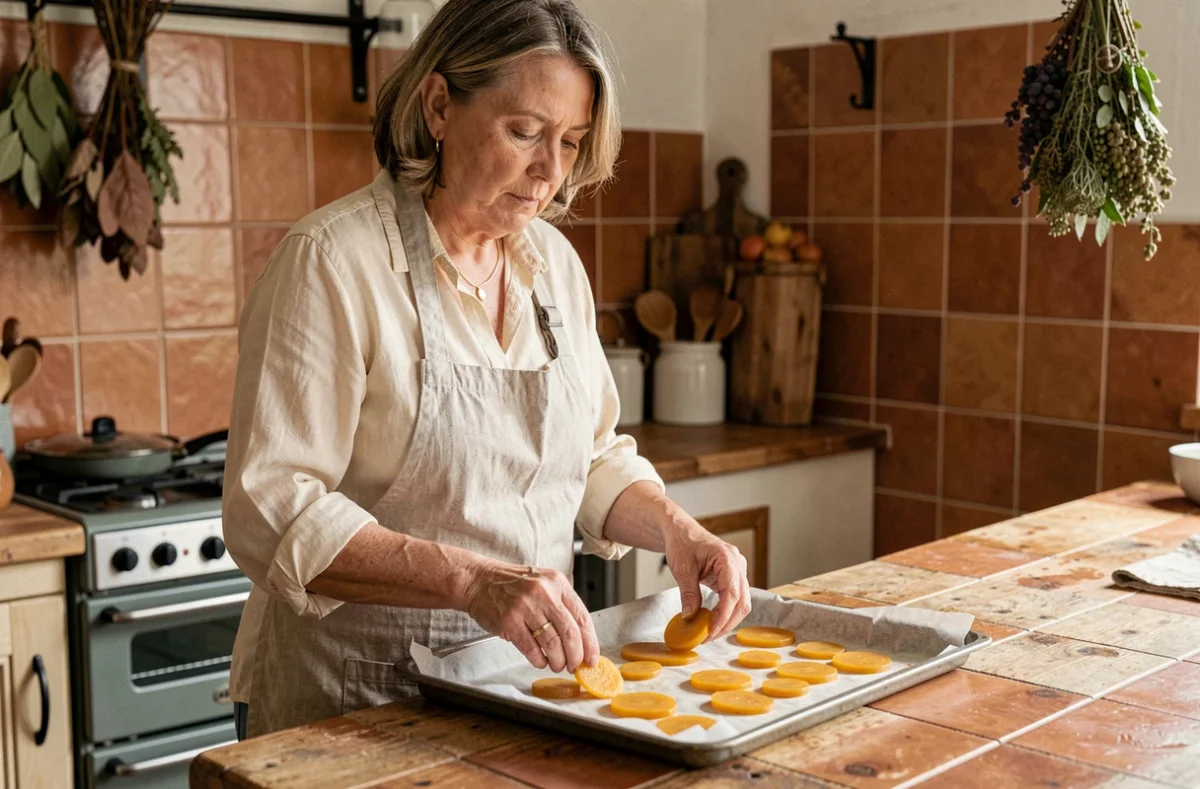
The cooking of quince paste generally does not pose major difficulties. Drying, on the other hand, is the phase where the final texture is determined: a sticky paste, crusty on the surface but soft in the center, or on the contrary firm, sliceable, and satin-like. Here we detail the technical parameters that make the difference between approximate drying and a stable result.
Temperature and oven ventilation: the thresholds to respect
An oven set too high is the primary cause of failure. Beyond 60 °C, the sugar present in the paste begins to caramelize on the surface. A dry crust then forms, trapping residual moisture inside. The result: a brittle exterior and a center that remains sticky.
We recommend working at around 50 °C, with the oven door slightly open. The slight opening allows steam to escape continuously. Without this airflow, moisture stagnates in the chamber, and drying slows down considerably, or even reverses due to condensation on the paste itself.
The convection function, if your oven has it, significantly improves the uniformity of the airflow. In static mode, areas close to the heating element dry faster than the center of the tray. Forced ventilation reduces this gap and shortens the overall drying time.
Before attempting to dry quince paste in the oven, check that your thermostat actually goes down to this low range. Some domestic ovens display 50 °C but poorly regulate below 80 °C. An independent oven thermometer clears up any doubts.
Turning and thickness: two underestimated variables for drying quince paste
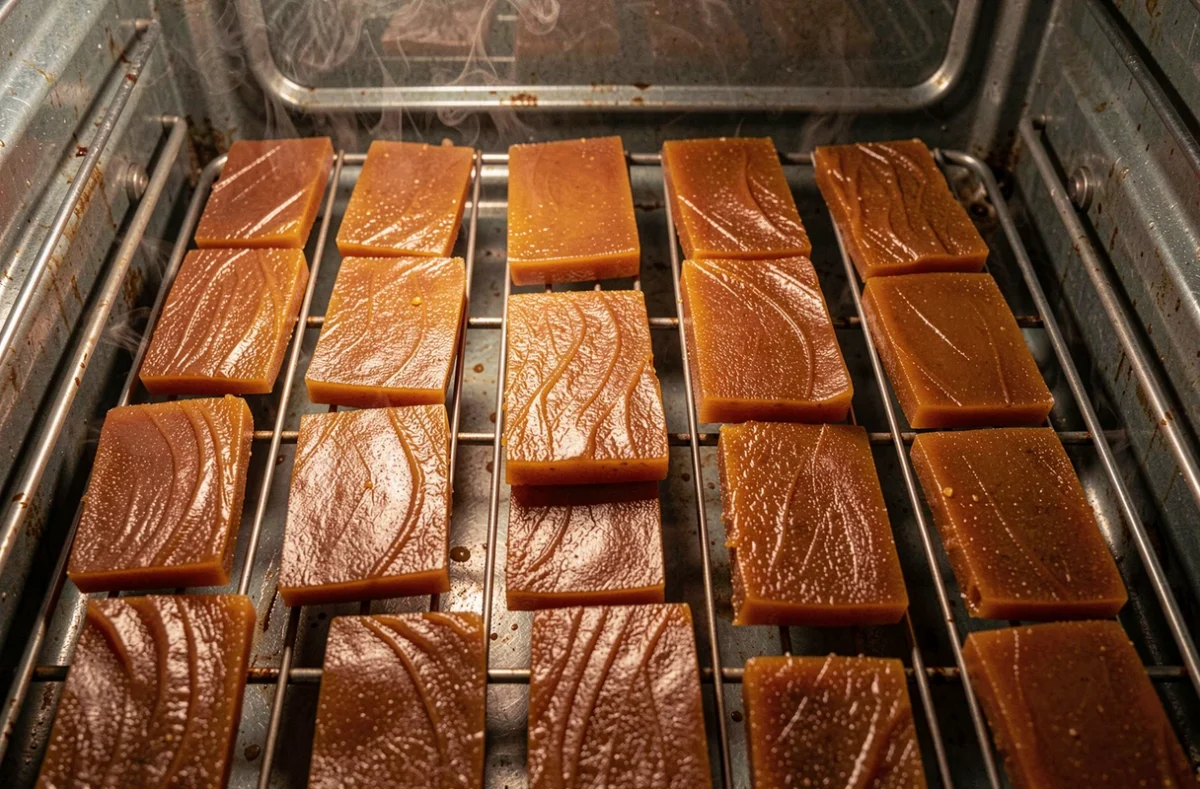
The thickness of the pour directly affects the drying time. A thin layer (around one centimeter) dries much more evenly than a thick mass of several centimeters. The thicker the paste, the greater the moisture difference between the surface and the center.
Turning the paste halfway through is a technical step not to be overlooked. The underside, pressed against the parchment paper, remains in permanent contact with the moisture it releases. Without turning, this side remains soft while the top has already reached the desired texture.
The most reliable method is to gently peel the paste off the parchment paper after the first half of the time in the oven, then turn it onto a new clean paper. If the paste still sticks too much to be handled, extend the time by a few tens of minutes before trying again.
Water activity and actual stability of quince paste after drying
The touch sensation is not enough to judge whether a paste is properly dried. A surface that no longer sticks to the finger may hide a center that is still too moist for long-term storage. The relevant parameter is water activity, meaning the fraction of water still available for microorganisms.
In practice, without specialized measuring instruments, two reliable indicators allow for a judgment:
- The slice cuts cleanly, without the knife sticking or dragging any material
- The paste, left overnight in the open air on a rack, shows no shiny or oozing areas the next day
- The surface retains a slightly satin appearance, neither matte-powdery (too dry) nor shiny (still moist)
This last point is often misinterpreted. A matte and powdery appearance indicates excessive drying: the paste has lost its flexibility and will break instead of slicing. Proper drying falls within a narrow window.
Packaging after drying: avoiding moisture uptake
Never package quince paste while it is still warm. The condensation that forms in a closed container softens the surface within hours and can promote mold growth. We always allow the paste to cool to room temperature, on a rack, for several hours before any packaging.
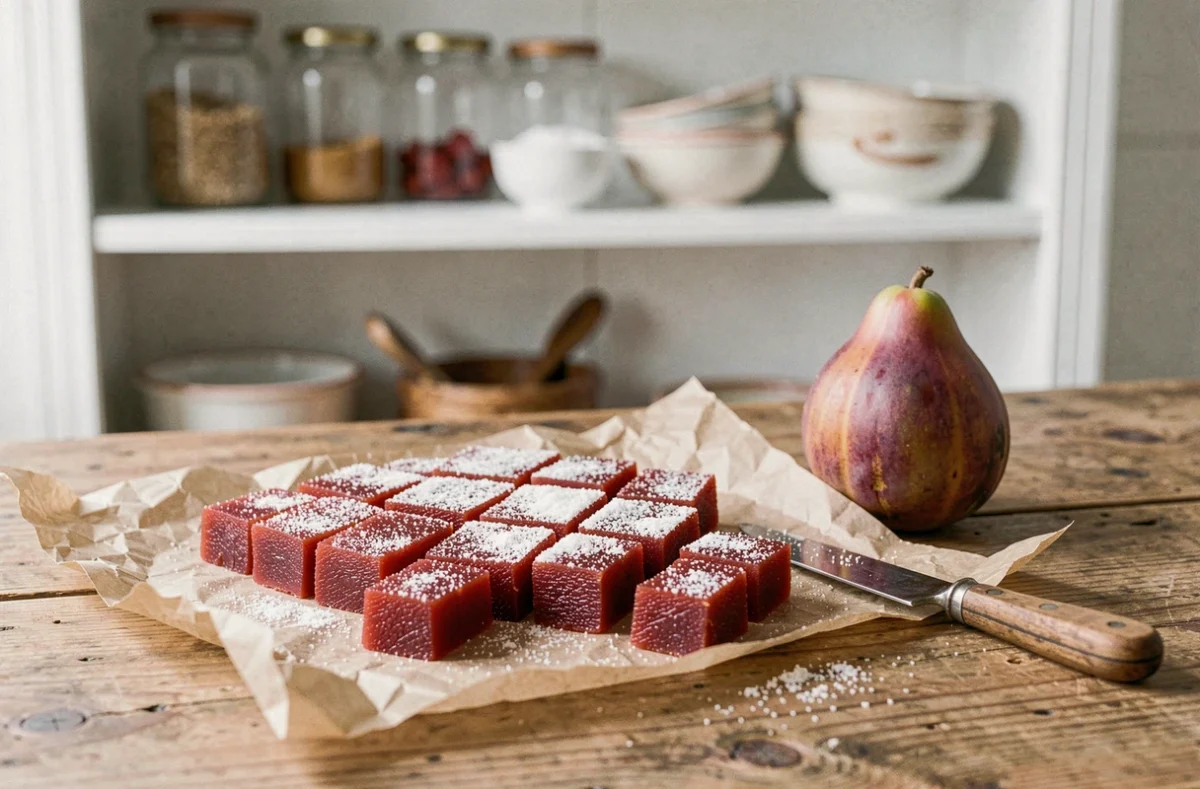
Once cooled, cutting into pieces precedes storage. Interleave parchment paper between each layer to prevent the pieces from sticking together. The ideal container is a rigid box, neither completely airtight nor open:
- A metal box with a lid simply placed (not clipped) allows the paste to breathe while protecting it from dust
- A tightly wrapped plastic film traps residual moisture and softens the surface within a few days
- A humid ambient environment (kitchen by the sea, poorly ventilated room) accelerates moisture uptake even on well-dried paste
Ambient humidity can alter the texture after drying. A properly dried paste can soften in a box exposed to humid air. If you notice this phenomenon, a brief stint in the oven at 50 °C, with the door slightly open, can help re-stabilize the surface.
Signs of failed drying and possible corrections
A sticky quince paste after several hours in the oven almost always indicates a temperature that is too high or a lack of ventilation. The surface crust has sealed in the moisture. The correction involves cutting the paste into smaller pieces to increase the evaporation surface, then resuming drying at 50 °C with ventilation.
A paste that crystallizes on the surface has undergone excessive prolonged heat. The recrystallized sugar gives an unpleasant sandy texture. This defect is irreversible on the affected pieces. It is better to have several short passes in the oven than one overly long drying session.
Color also provides an indication. A quince paste that turns dark brown during drying has exceeded the caramelization threshold. At 50 °C, the hue should remain in the orangish-pink to dark red tones, depending on the variety of quince and the initial cooking time. Any significant browning during drying indicates an adjustment that needs to be corrected.
Drying quince paste in the oven remains an operation of patience rather than complex technique. Low temperature, ventilation, turning, complete cooling before packaging: these four points cover almost all common failures. The rest is a matter of practice and observation.