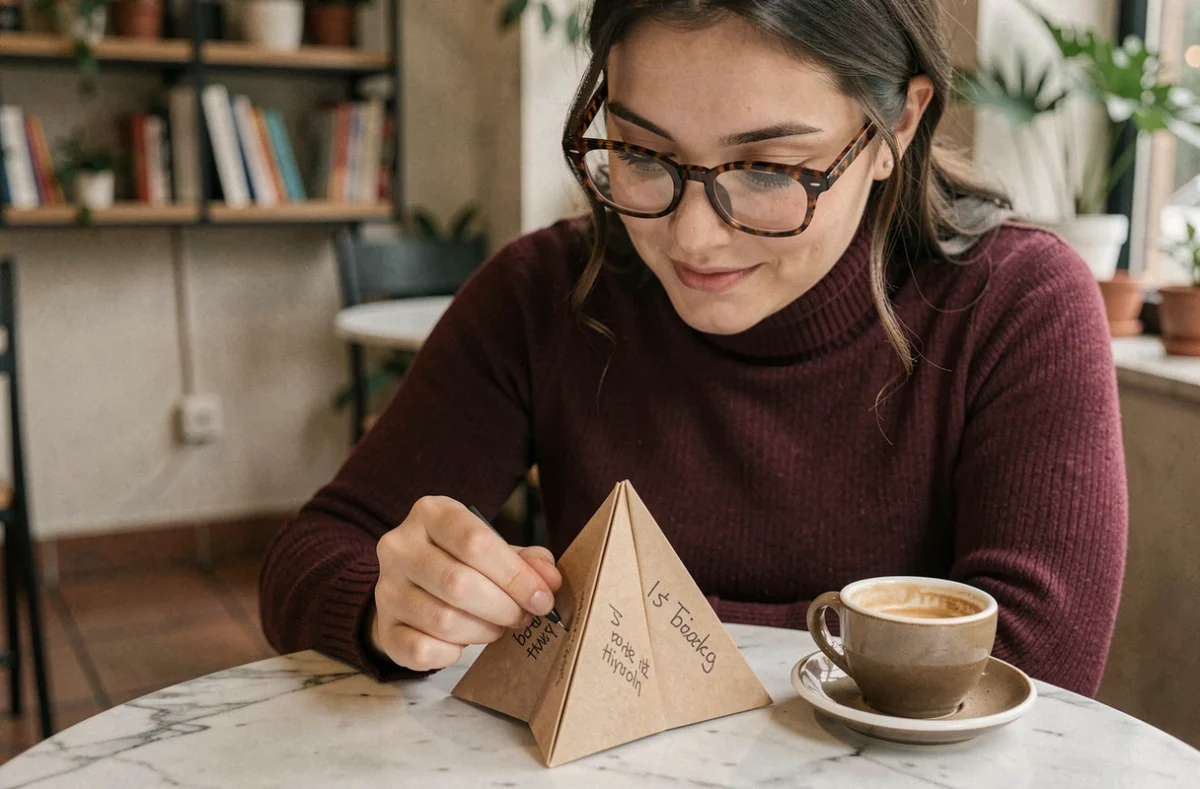
The paper fortune teller is not limited to playgrounds. Used at parties, seminars, or during a dinner, it becomes a remarkably effective entertainment tool, provided that the content written on each flap is well thought out. We have selected twenty concrete prompts, tested in various adult contexts, that avoid the pitfalls of infantilizing dares or overly intrusive questions.
Each idea below operates on one principle: to propose an exchange with low emotional risk while generating genuine interaction. The right to pass remains the basic rule of any successful fortune teller.
1. Most improbable travel memory
Asking each player to recount an unexpected moment experienced while traveling produces short and often funny stories. The phrasing “Share your most improbable travel memory” works better than a vague “Talk about your vacation” because it targets the anecdote, not the summary.
This prompt also serves as an icebreaker in a group where participants do not all know each other. We recommend placing it on one of the first flaps to kick off the dynamic.
2. Hidden talent that no one suspects
Writing “What secret skill do you have?” on a flap encourages each player to reveal an unknown talent. Playing the tuba, knowing how to juggle, speaking a rare language: the hidden talent creates surprise without forcing intimacy.
If you’re looking for suggestions for an adult paper fortune teller, this type of question illustrates the balance between lightness and authenticity that sets it apart from child versions.
3. Absurd dilemma to resolve in ten seconds
The absurd dilemma (“Live without cheese or without music?”) generates instant debates. The constraint of answering in ten seconds prevents over-analysis and keeps the pace of the game.
Preparing three or four dilemmas per fortune teller is sufficient. Beyond that, the element of surprise diminishes.
4. Mime of an improbable profession
Mime remains one of the most effective formats for breaking the ice in new teams. Writing “Mime a profession you could have had in another life” on a flap turns the fortune teller into a brief physical activity.
The mime also works in a professional context, provided that each participant is free to pass their turn without justification.
5. Song to hum for others to guess
Writing “Hum the chorus of a song that everyone knows here” forces the player to gauge the group’s tastes. It’s a musical variant of mime, accessible even to the most reserved.
6. Wacky prediction for the coming year
“Make an absurd prediction about one of the players for next year.” This type of prompt generates laughter without putting anyone in a difficult position, provided that “absurd” is specified to avoid awkward forecasts.
During a New Year’s Eve or a birthday, this idea makes perfect sense. You can even keep the fortune tellers and read them a year later.
7. “What if” scenario to develop in one sentence
Writing “What if you were president for an hour, what law would you pass?” encourages creativity. The “What if” format allows for humor, gentle provocation, or reflection, depending on the player’s temperament.
We prefer scenarios that do not have a right answer to avoid any implicit judgment.
8. Sincere compliment to the player on the right
Writing “Give a sincere compliment to the player on your right” turns the fortune teller into a tool for cohesion. The compliment directed at a specific neighbor prevents empty phrases addressed to the entire group.
This prompt works particularly well mid-game, when the group is already relaxed.
9. Imitation of a celebrity chosen by the group
The flap states “The group chooses a celebrity, you imitate them for fifteen seconds.” Entrusting the choice to the group rather than the player creates a collective and often hilarious dynamic.
10. Unconfessable culinary confession
“What dish, hated by everyone, do you secretly love?” Food is a universal and low-risk topic. This type of question sparks passionate debates without ever becoming personal.
11. Cooperative challenge in pairs
Writing “With the player opposite you, invent a slogan for an imaginary product in thirty seconds” introduces cooperation. Challenges in pairs reduce individual pressure and are suitable for mixed groups where some participants are more introverted.
12. Deliberately trivial philosophical question
“Is a hot dog a sandwich?” This type of falsely serious question provokes spontaneous arguments. The contrast between the solemn tone and the ridiculous subject is what makes it interesting.
Three to four questions of this type per evening are enough to keep the format from getting stale.
13. Childhood memory related to the playground
Asking “What playground game did you love?” ties the fortune teller back to its original context, schoolyard origami. Adults then share a nostalgic memory without any emotional risk.
14. Cultural recommendation in one sentence
“Name a movie, book, or series you would recommend without hesitation.” This flap has a concrete use: players leave with a list of recommendations. The fortune teller becomes a tangible cultural sharing tool.
15. Truth or fib for the group to guess
Writing “Share a fact about yourself, and the group must guess if it’s true or false” takes the principle of Two Truths and a Lie and condenses it into a single flap. The format works with all player profiles.
16. Forbidden word for five minutes
The flap indicates a common word (“yes,” “no,” “I”) that the player must not say for the next five minutes of play. Others monitor and count infractions. This format creates ongoing playful tension beyond the individual turn.
17. Absurd professional anecdote
“Share the most absurd situation you’ve experienced at work.” In seminars or team-building activities, this prompt taps into shared experiences without touching on private matters. Professional anecdotes are generally perceived as less intimate than personal ones.
18. Small drawing to guess in thirty seconds
Have a pencil and a piece of paper next to the fortune teller. The flap states “Draw an everyday object, and others guess.” The drawing replaces words and is suitable for players less comfortable with verbal expression.
- Choose simple objects (cup, bike, hat) to keep the challenge accessible
- Limit the time to thirty seconds to maintain the pace
- Prohibit letters and numbers in the drawing to make the exercise more challenging
19. Gentle physical dare accessible to all
A dare like “Do three squats” or “Balance on one foot for ten seconds” keeps the group’s energy up. The accessibility of the physical dare should be considered from the design stage: avoid any challenge that excludes people with reduced mobility.
Always provide a verbal alternative for each physical dare to ensure the inclusion of all players.
20. Personalized message written by the host
Rather than printing a generic template, writing a unique message on each flap, tailored to the present group, distinguishes your fortune teller from all standardized versions. A shared memory, an inside joke, a reference to a common event: this level of personalization transforms a simple fold into a memorable object.
The adult paper fortune teller gains impact when each prompt is calibrated for the specific group that will play. Mixing light questions, cooperative challenges, and moments of cultural sharing creates a varied rotation where no one gets bored. The only technical imperative remains to remind, before the first turn, that each player can pass without justification.